
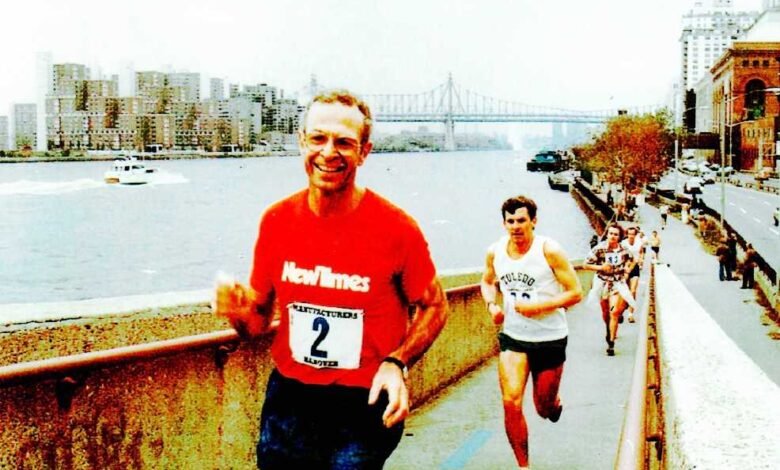
The last living founder of the New York City Marathon’s five-borough course remembers how it all came together to transform the competition into an international event.
George Hirsch is the publisher of New York Magazine and a fan of keeping himself active. At 92 years old, he still runs on the treadmill and recently took up boxing a couple of years ago.
While a lifelong runner, Hirsch only started taking the exercise seriously in the latter half of the 1960s. “People sort of considered runners a little bit strange, kind of oddballs,” recalls Hirsch.
That all changed when American Frank Shorter took home the gold in the 1972 Olympic marathon. There were also other factors coalescing around running in the decade of the 1970s. “The awareness of taking care of yourself, and getting fit,” explains Hirsch, “wellness became a thing where you could improve the quality of your life.”
The 1970s are regarded as a time when running boomed in popularity, giving Hirsch and his 4 co-founders an ample opportunity to start a city-wide marathon. According to Hirsch, at the time, “the idea of an urban marathon was unknown. It didn’t exist.”
New York City hosted its first marathon in 1970, which consisted of four laps around Central Park. But Hirsch had a grander vision for what New York City could achieve in the realm of running.
To achieve that vision, Hirsch came together with four other avid runners with shared qualities of influence and persistence: Percy Sutton, the Manhattan Borough President; George Spitz was a “New York gadfly” who ran for various city government positions for fun and petitioned at all hours of the day and night; Ted Corbitt, known in the growing but still tight-knit running community for being the first African-American man to represent the United States in an Olympic marathon; and Fred Lebow, a Holocaust survivor, originally from Arad, Romania, and the president of New York Road Runners.
The 5-Boro Marathon, then and now
When Hirsch and his fellow founders were pushing for their idea of an all-encompassing city marathon, they were met with little resistance. At the time, New York City “was on the edge of bankruptcy and crime was sky-high,” Hirsch recalls.
Five decades later, New York City has gone through many changes, and so has the marathon.
Now, there is only a 1% chance of potential participants being admitted into the marathon. The demand to run has greatly surged since 1976. According to Hirsch, New York City Road Runners sell out their events each week.

Once the marathon route was approved and Hirsch was at the starting line on Staten Island, he took in the surreal surroundings at the Verrazzano Bridge. There were helicopters flying overhead and tug boats spraying water down below. The spectacle only continued when they turned the corner off of Queensboro Bridge onto First Avenue. At this point in the race, Hirsch realized that “before we even finished the race we knew this thing was working.”
The story that Hirsch remembers the most fondly on the first 5-Boro marathon was the moments after crossing the finish line.
Thoroughly worn out, Hirsch finally spotted Frank Shorter, who had come in second place after Bill Rogers. They had to go downtown. As they were walking out of Central Park, Hirsch turned to Shorter, realizing he did not have a critical tool to get them downtown:
“Frank, I don’t have any money. He said I don’t have any money either. So we started hitchhiking on Central Park West. And these two guys pulled up. They had come from Philadelphia to see the marathon. So we jumped in and they asked where we were going. Then he looked in the mirror and said, ‘oh my god Frank Shorter!’ And I said, ‘we’re going to 32nd street. And the driver said, ‘how about Miami.”’
Bill Rogers, however, had a more somber situation awaiting him after the ultimate runner’s high of coming in first place. As he carried his trophy to his parking spot, he was in for a shock when his car was not there, having been towed away.
Gary Muhrcke: Winner of the first NYC marathon
Being the first to win the New York City marathon in 1970 when it was just four laps around Central Park, Gary Muhrcke continued to run after the creation of the 5-boro marathon. While he took home the glory in the 1970 race, he is more fond of the constant new terrain that the 5-boro marathon offered.
“Running a marathon on loops is not the most fun thing to do,” Muhrcke said.
Even though he is not training for 26.2 miles anymore, Muhrcke is still aware of how the sport has changed. Back when he participated in the 5-boro marathon, the clock stopped at 4 hours because the participants were much more competitive with their race times.
“They were much more serious runners,” says Muhrcke, “now, people are just participating for their bucket list.”
The marathon’s role to the city since its founding
Since its founding in 1976, the 5-borough marathon has served as a unifying force for the city. Hirsch brings up 9/11 as a preeminent example. The attacks on the World Trade Center occurred only 6 weeks before the marathon.
New Yorkers were in need of the marathon as a device to build camaraderie after a core-shattering event such as 9/11.
The crowds were larger than the marathon participants due to the fact that, “a third of the runners come from overseas,” according to Hirsch.
The international element of the TCS New York City Marathon is what Hirsch thinks separates this marathon from the rest: “Boston it’s traditional, Chicago and Berlin are flat and fast, but for New York it’s international. It’s a global city, I’d say, in a way. Therefore, it’s the global marathon.”
Source link