
As more than 90,000 out-of-town visitors descend on the Bay Area for Super Bowl weekend, Chabad rabbis are geared up and ready for kickoff.
“We brought in shmaltz herring from New York,” said Rabbi Moshe Langer of Chabad of SF, describing preparations for a festive Shabbat meal on Saturday.
The Chabad center will host some 70 people for Friday night dinner at its Nob Hill location, plus the Saturday Kiddush. On game day, Langer said Chabad plans to send its “Mitzvah Cable Car” 50 miles to Santa Clara and Levi’s Stadium “to go around and pray with people and wrap tefillin.” The vehicle is a replica of a San Francisco cable car that runs on an engine.
Sunday’s Super Bowl is being hosted in the Bay Area for the first time since 2016. The tens of thousands of visitors will deliver a boost of economic activity to the region — and a traffic headache for locals.
The Chabad-Lubavitch movement, a branch of Hasidism that is headquartered in Crown Heights, Brooklyn, seeks to connect Jews worldwide with Jewish religious practices, sending emissaries, known as shluchim, to cities and rural areas across the globe.

Chabad of SF will also hand out bowls of matzah ball soup and care packages to homeless people in downtown San Francisco “in honor of the Super Bowl,” Langer said.
Chabad of Santa Clara, more centrally located about a mile from Levi’s Stadium, will serve as a hub for religiously observant Super Bowl attendees.
“We’re providing spiritual logistics,” said Rabbi Yigal Rosenberg, director of Chabad of Santa Clara along with his wife, Elana Rosenberg.
The Chabad house published a list of community resources for Jewish visitors, including kosher restaurants, grocery stores, daily minyans and mikvahs, or ritual baths, in the area.
For what he’s calling “Touchdown Shabbat,” Rosenberg said the Chabad house plans to host around 100 people for Friday night dinner.
“As the city fills with Super Bowl energy, Friday night ushers in something deeper,” the webpage for Touchdown Shabbat states. “Shabbat in Santa Clara is a chance to slow down, unplug, and step into an atmosphere of warmth, song, and connection.”
On Sunday, Chabad of Santa Clara will host morning and afternoon prayers followed by a kosher tailgate serving steak, wings and, of course, beer. Transportation to the stadium will be provided After the 3:30 p.m. game, the Chabad center will host an evening prayer service at 9:30 p.m.
“Our main message is, you can be a Jew anywhere,” Rosenberg said.
Football is a “very American sport. It’s something that Americans do,” he said. “You can do it and still do it in a Jewish way.”
Rosenberg observed that most of the out-of-town guests who signed up for Touchdown Shabbat are fans of the New England Patriots, not the Seattle Seahawks, perhaps owing to the Boston area’s large Orthodox population.
Still, he said, Chabad will be wrapping tefillin on Sunday morning to support both teams.
Both Langer and Rosenberg said they plan to brave Sunday’s crowds to do what the Chabad movement is perhaps most known for: facilitating the observance of Jewish mitzvot, such as offering boys and men the opportunity to wrap tefillin.
“We’ll probably wind up doing a service there in the afternoon at Levi’s Stadium. And be there for tefillin,” said Rosenberg, who also serves as a chaplain for the local police department.
Rosenberg said his efforts to center Judaism amid the football frenzy are in part an homage to his father, Rabbi Yosef Rosenberg, who died last year.
The elder Rosenberg is considered a pioneer in the Chabad movement, who in the late 1980s was central to the legal effort to allow Hanukkah menorahs in public spaces. Today, menorah lightings are ubiquitous in American cities, providing public visibility to Jewish religious practices.
“We’re continuing that legacy,” the younger Rosenberg said.
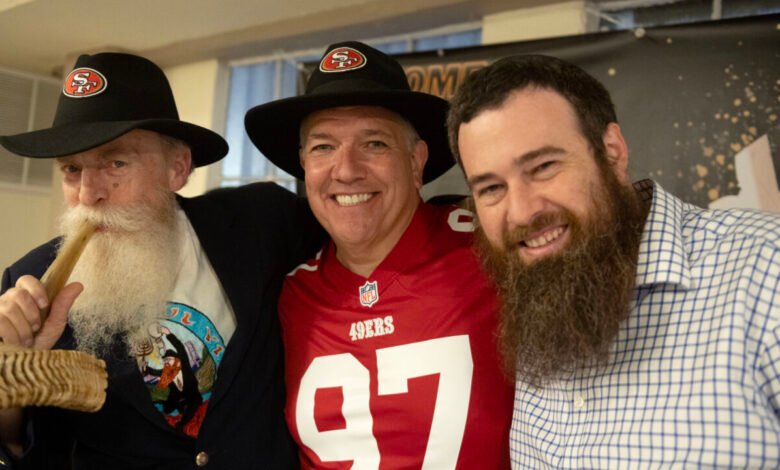
For Langer, the opportunities presented by the Super Bowl are nearly endless. He said another idea, still in the works, involves his father, Rabbi Yosef Langer, the one-man San Francisco institution known as the “Rally Rabbi.”
“We’re trying to get somebody to put my father on the 50-yard line to blow the shofar,” Moshe Langer said. “We’re still working on that.”