
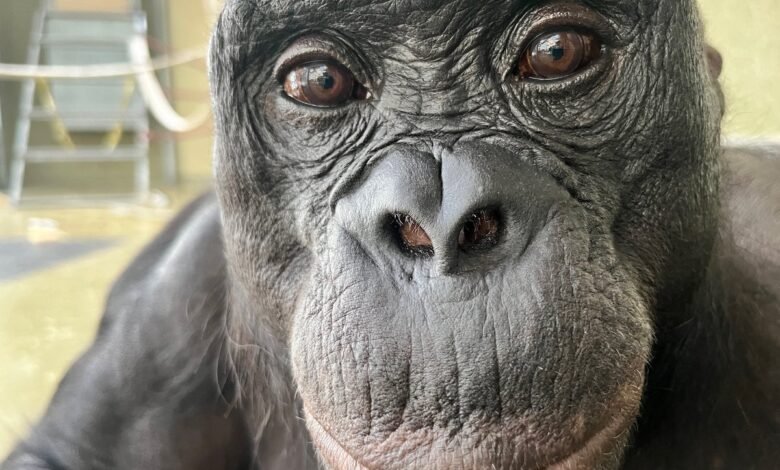
Amalia Bastos first met Kanzi the bonobo in 2023. Bastos was “starstruck,” she recalls: Kanzi was famous for learning how to communicate with humans using a keyboard of symbols. Upon first seeing Bastos, Kanzi immediately pointed at her and another scientist. Then the ape pointed to his “lexigrams”—the symbols he used to communicate—selecting the icons for “chase” and “tickle.”
The two researchers obliged, pretending to chase and tickle each other. “[Kanzi] found that highly entertaining,” Bastos recalls. “And I was like, ‘We’re not actually chasing or actually tickling each other, but he seems satisfied with this sort of puppet show that he’s put together.’”
Bastos, then an incoming postdoctoral fellow at Johns Hopkins University, had traveled to the Ape Cognition and Conservation Initiative in Iowa with a group of researchers to observe and interact with Kanzi and the other animals at the center.
On supporting science journalism
If you’re enjoying this article, consider supporting our award-winning journalism by subscribing. By purchasing a subscription you are helping to ensure the future of impactful stories about the discoveries and ideas shaping our world today.
But Bastos’s encounter with Kanzi sparked a question: Could the animal understand the difference between pretend actions and real ones? In a new study published in Science on Thursday, Bastos and her co-author lay out the evidence that, yes, Kanzi could understand pretend objects in a controlled setting.
The findings indicate that bonobos—or at least that Kanzi had—have the capacity to imagine, says Christopher Krupenye, an assistant professor of psychological and brain sciences at Johns Hopkins and senior author of the paper. “We are not the only animals with rich mental lives that can extend beyond the here and now,” he says.
To test her hypothesis, Bastos designed the study around developmental psychology research in children from the 1980s in which the participants had a pretend birthday or tea party.
Instead of tea, Bastos opted for fruit juice. Then she and her team showed Kanzi two empty transparent cups and an empty jug. The researchers pretended to put juice into the cups and then “poured out” one of them. They then asked Kanzi where the juice was. He pointed to the cup that hadn’t been poured out.
If Kanzi had no conception of pretend objects, then his answer would be random, Bastos explains. But in the experiment, the bonobo correctly pointed to the cup that still had “juice” more often than he would have by chance. Bastos repeated the experiment with pretend “grapes” and, again, Kanzi performed better than chance. And in another experiment, Kanzi was given a choice between fake and actual juice. Perhaps unsurprisingly, as a juice lover, he tended to choose the real thing.
The results weren’t a complete surprise to Bastos; there is some evidence of chimps engaging in similar behavior, she says. Female chimpanzees, for instance, have been seen cradling sticks and carrying them like infants. In another case, a captive chimpanzee appeared to drag an invisible object on the floor in the same way that he’d usually play with wooden blocks.
Martin Surbeck, an evolutionary biologist at Harvard University, who studies wild bonobos, says the new study supports what many researchers who observe animals in the wild have long suspected: that some apes can understand pretend objects. But he cautions that it remains unclear why bonobos might have this ability or in what contexts it might be used.
Daniel Povinelli, a biology professor at the University of Louisiana at Lafayette, is more skeptical. It’s not possible to know for certain whether Kanzi understood imaginary objects “in the human sense” or whether the bonobo just recognized that one cup hadn’t been touched by the researcher, he says. What the study does show, Povinelli argues, is that Kanzi can follow “complex, human-guided interaction structures,” but it “does not resolve the deeper question of what kinds of concepts underlie Kanzi’s performance.”
Bastos hopes the results will offer insights to whether some animals have the ability to distinguish between the here and now and more abstract realities—planning for the future, for example, or being able to pretend. Unfortunately, future studies won’t involve Kanzi; he died last year at the age of 44.
Study co-author Krupenye adds that the experiment could foster a greater appreciation for bonobos, an endangered species—as well as animal cognition research broadly. “My hope is that our discovery will fuel growing research [efforts] to understand what kinds of imagination animals share with humans and which species possess these capacities,” he says.
It’s Time to Stand Up for Science
If you enjoyed this article, I’d like to ask for your support. Scientific American has served as an advocate for science and industry for 180 years, and right now may be the most critical moment in that two-century history.
I’ve been a Scientific American subscriber since I was 12 years old, and it helped shape the way I look at the world. SciAm always educates and delights me, and inspires a sense of awe for our vast, beautiful universe. I hope it does that for you, too.
If you subscribe to Scientific American, you help ensure that our coverage is centered on meaningful research and discovery; that we have the resources to report on the decisions that threaten labs across the U.S.; and that we support both budding and working scientists at a time when the value of science itself too often goes unrecognized.
In return, you get essential news, captivating podcasts, brilliant infographics, can’t-miss newsletters, must-watch videos, challenging games, and the science world’s best writing and reporting. You can even gift someone a subscription.
There has never been a more important time for us to stand up and show why science matters. I hope you’ll support us in that mission.
Source link