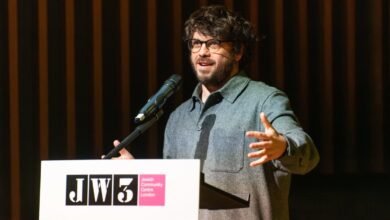

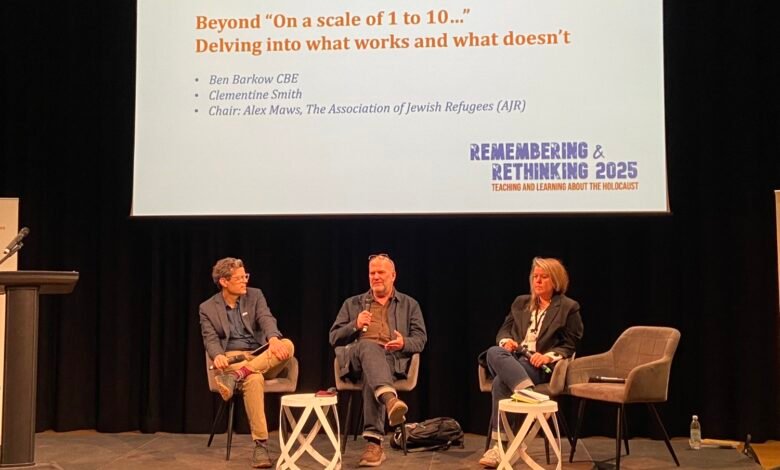

The breadth of participants testified to the research findings of Ben Barkow (former director of the Wiener Library) that “the field is large and diverse and able to support a wide range of approaches and levels of interest in the subject”, despite the shrinking of humanities and history provision in schools and universities. Barkow and others wondered why we expect to draw out ‘lessons’ from the Holocaust, when we don’t demand them elsewhere. Indeed, within the school curriculum, teaching of the Holocaust is often presumed to foster the training of civic and moral responsibilities, like no other history (of the Romans, for example, or of the Tudors).
An imaginative approach to the subject has been initiated by Holocaust Centre North. Artists, writers and translators were invited to respond to their collection and the resulting partnerships have elicited inventive forms of engagement, where the experiences of survivors – Jewish, Roma and LGBTQ+ – also speak to that of the wider community. Artist Laura Nathan listened to survivor and multigenerational interviews from the museum archives, while unpicking a Gannex raincoat, made in the factory founded by Holocaust survivor Joseph Kagan. The threads became part of an installation for the Memorial Gestures exhibition.
Source link