

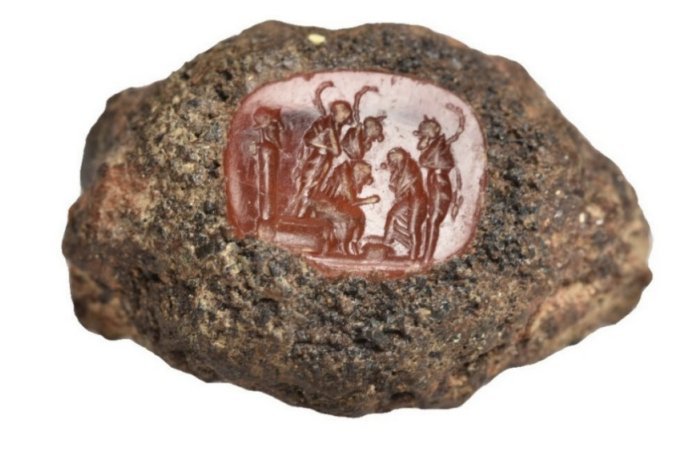
Jan Bartek – AncientPages.com – About 2,100 years ago, an ancient artisan achieved the near-impossible: carving an intricate, multi-character theatrical scene onto a single gemstone measuring a mere 13 millimeters wide.
For centuries, surviving artifacts from this era have followed a strict, predictable rule—one well documented in institutions like the British Museum. But a newly analyzed discovery has just shattered that historical consensus.
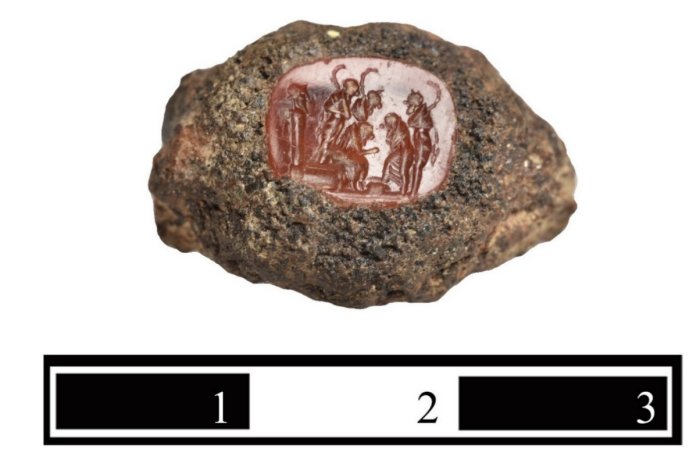
Ring from the Gaye Çarmıklı Collection depicting a Satyr Play. Credit: Arslan, M., & Bulut, A. E. (2026). CEDRUS: The Journal of Mediterranean Civilizations Studies, (14)
Set into a heavily corroded iron ring, this microscopic masterpiece features a radical stylistic departure that has never been documented in the ancient world. By breaking established conventions of classical craftsmanship, it reshapes how scholars view the relationship between ancient performance, myth, and art.
Who owned this high-status luxury item? How did a craftsman achieve such forensic precision millennia before the magnifying glass? And what secrets does it reveal about the lost, lively world of ancient drama?
The Magnificent Tiny Ancient Artifact
In a major breakthrough for classical archaeology and the visual history of the performing arts, researchers have unveiled an astonishingly detailed ancient Greek theater scene carved into a 2,100-year-old carnelian gemstone measuring just 13 by 11 millimeters.
The rare artifact, which is set into a heavily corroded iron ring, belongs to the Gaye Çarmikli Collection and is registered as a movable cultural property affiliated with the Ankara Ethnography Museum.
The miniature masterpiece offers an unprecedented glimpse into ancient glyptic art. In a comprehensive study published in the journal Cedrus, researchers Melih Arslan and Ahmet Emirhan Bulut examined the intaglio and dated the object to the first half of the 1st century BC. Their findings reveal not only a staggering level of microscopic craftsmanship but also a profound departure from traditional ancient theatrical iconography.
A Masterpiece In Miniature
The stone itself is a vibrant reddish-caramel carnelian. Despite a surface area smaller than a standard human fingernail, an anonymous ancient stone master successfully engraved five primary figures, a decorative pillar, and a subtle background character within its narrow borders. The composition achieves remarkable complexity through the varied postures, intricate garments, and symbolic objects held by the figures.
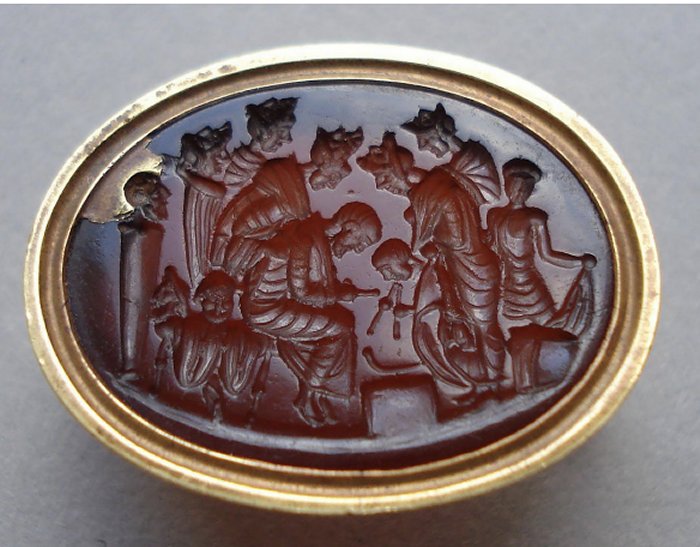
Sard ring stone with a depiction of a theater play (British Museum, reg. no. 1913,0307.186). Credit: Arslan, M., & Bulut, A. E. (2026). CEDRUS: The Journal of Mediterranean Civilizations Studies, (14)
To understand how such an intricate feat was accomplished roughly two millennia ago, the researchers utilized microscopic analysis to identify the artisan’s techniques. The master employed the classic intaglio method, carving the figures directly into the stone’s surface to create a negative impression. Microscopic examination revealed distinct traces of round-tipped drills used to map out the initial body outlines. The delicate folds of the characters’ clothing were executed using rotary abrasives of varying thicknesses, while minute, pinpoint perforations were deployed to form the noses and facial features of the figures.
At the center of this microscopic drama sits a long-garmented male figure. He is depicted looking intently at a two-leaf tablet, a posture that led the researchers to identify him as a poet or a playwright reviewing his script. Directly opposite him stands a figure with one foot firmly planted on a stone—a pose often associated in classical art with the leader of a theatrical chorus.
The remaining figures surrounding the central playwright are instantly recognizable by their distinct mythological attributes, including horns, animal tails, and curved hunting staffs, known historically as a lagobolon or pedum. These features firmly link the characters to the half-human, half-animal satyrs who served as the wild, hedonistic attendants of Dionysus, the ancient Greek god of wine, ecstasy, and theater.
The Muse In The Background
On the far left side of the composition stands a bearded herm. In the ancient Greco-Roman world, a herm was a sacred statue consisting of a sculpted head or bust resting atop a plain, square stone pillar. In this context, the herm represents Dionysus himself, serving as both a decorative stage element and a powerful symbolic nod to the religious origins of Greek drama.
However, the micro-detail immediately behind the deity has sparked intense academic interest. Tucked into the background, the artisan carved a minute female figure with hair flowing freely down her back and arms extended outward to her sides.
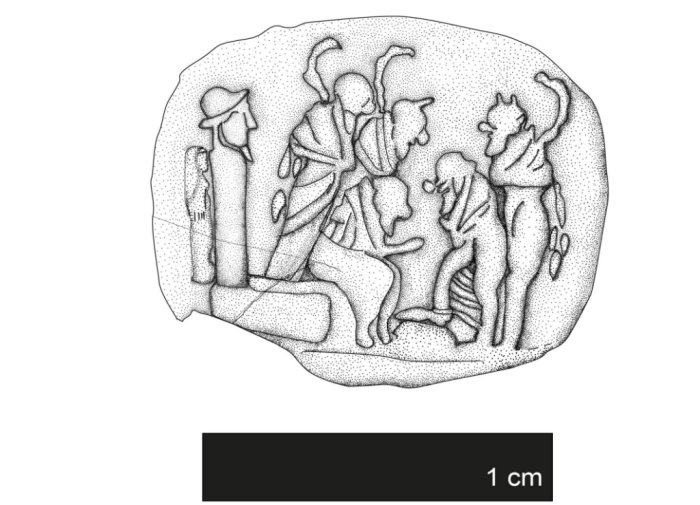
Detail of the ring stone(R. Selim). Credit: Arslan, M., & Bulut, A. E. (2026). CEDRUS: The Journal of Mediterranean Civilizations Studies, (14)
Arslan and Bulut propose that this hidden figure represents Thalia, the mythological Muse of comedy and light-hearted poetry. As one of the nine Muses born to Zeus and Mnemosyne, Thalia was revered in antiquity as the divine source of inspiration for comedic writers and performers. Given the gemstone’s overtly theatrical theme, including Thalia is a logical and highly sophisticated iconographic choice by the artist, though researchers note her identity remains a strong hypothesis rather than a definitive certainty.
A Radical Departure From Tradition
What elevates the Çarmikli ring stone from a beautiful curiosity to an archaeological treasure of international significance is its unique narrative perspective. The representations of theater plays on engraved gemstones are exceptionally rare in the surviving corpus of ancient glyptics. The few comparable examples that do exist—such as those preserved in the British Museum in London and the Rijksmuseum van Oudheden in the Netherlands—traditionally follow a rigid iconographic formula.
In those standard depictions, the scene is explicitly framed as a backstage rehearsal. The actors are shown gathered around a seated poet, but their theatrical performance masks are pushed up onto the tops of their heads or held in their hands rather than being worn. This visual cue reminds the ancient viewer that they are watching human actors preparing for a show.
The Çarmikli gemstone completely breaks away from this convention. The artisan omits the theatrical masks entirely, opting instead to render the actors as literal, living mythological satyrs. Arslan and Bulut argue that this distinction suggests the intaglio does not capture a human rehearsal, but rather the live performance of the play itself, or perhaps the idealized mythic narrative the play was based on. The direct transformation of actors into pure mythological entities represents a previously undocumented iconographic approach among known classical theatrical reliefs and gemstones, filling a critical gap in our understanding of ancient visual culture.
The Satyr Play Context
To appreciate the ring’s cultural value, one must look to the specific genre it honors: the satyr play. In the theatrical festivals of classical Athens, such as the City Dionysia, dramatic competitions required playwrights to present a tetralogy: three tragedies followed by a single satyr play.
Satyr plays served as comic relief, intentionally framing tragic, mythic themes around a rowdy, boisterous chorus of satyrs. These plays parodied the heavy, somber themes of the preceding tragedies, offering the audience a lighthearted, Dionysian release. Despite their immense popularity in antiquity, very few texts survived the collapse of the ancient world; Euripides’ Cyclops remains the only complete satyr play available to modern scholars. Because textual records are so scarce, visual artifacts like the Çarmikli ring stone provide irreplaceable evidence of how these beloved performances were staged, costumed, and perceived by ancient audiences during the Hellenistic period and the Roman Republic.
Unlocking The Secrets Of The Owner
Because the artifact did not surface during a modern, controlled scientific excavation, tracing its exact history challenges historians. The ring passed through the private art market before arriving in the Gaye Çarmikli Collection. While the precise archaeological context and find-spot are officially unconfirmed, archival museum records suggest that the object originally originated near the ancient city of Sardis—the historical capital of the iron-age Kingdom of Lydia, located in modern-day western Türkiye.
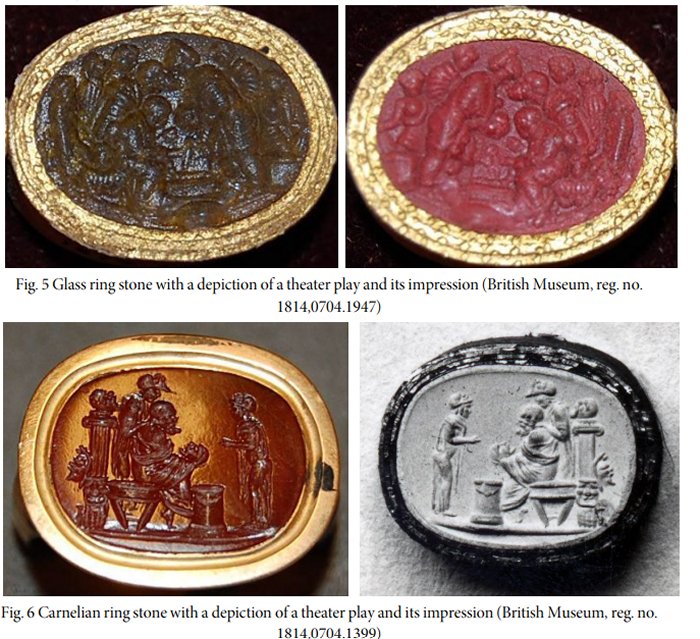
Carnelian ring stone with a depiction of a theater play and its impression (British Museum, reg. no.
1814,0704.1399). Credit: Arslan, M., & Bulut, A. E. (2026). CEDRUS: The Journal of Mediterranean Civilizations Studies, (14)
Time and the elements have taken a toll on the artifact’s metallic structure. The ring’s iron shank has almost completely disintegrated over the centuries, leaving only a heavily corroded, fragile fragment of the band. The carnelian gemstone, however, proved far more resilient. Despite two hairline fractures and minor surface wear, the gemstone’s structural integrity remains intact, and the micro-carvings of the five figures remain perfectly legible to modern researchers.
See also: More Archaeology News
The engraving’s highly specialized, niche subject matter raises fascinating questions about the ring’s original owner. In the 1st century BC, wearing an iron ring set with a custom-carved gemstone signaled status, identity, and personal taste. Arslan and Bulut propose that the jewelry did not belong to an ordinary citizen, but rather to a high-ranking theater professional, a successful playwright, a lead actor, or an exceptionally wealthy patron of the dramatic arts. For an ancient artist or impresario, wearing a microscopic depiction of a satyr play on their finger would serve as the ultimate symbol of their occupational pride and lifelong dedication to the cult of Dionysus.
Ultimately, the Çarmikli ring stone stands as an extraordinary testament to the sophistication of ancient artists, proving that the grand scale of Greek theatrical tradition could be captured in all its complexity within the confines of a single centimeter of stone.
Written by Jan Bartek – AncientPages.com Staff Writer
Expand for references
Arslan, M., & BULUT, A. E. (2026). A Rare Ring Stone Depicting a Satyr Play. CEDRUS: The Journal of Mediterranean Civilizations Studies, (14), 391–404. https://doi.org/10.5281/zenodo.22642626