

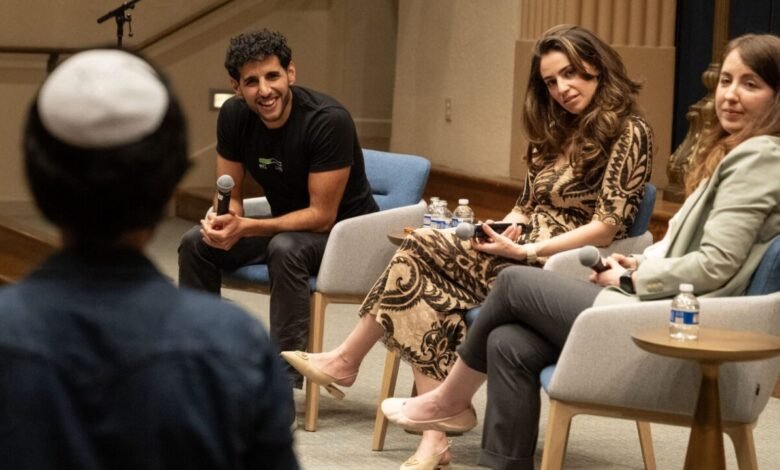
Nas Daily, the Israeli Palestinian social media entrepreneur whose short videos have been viewed roughly 20 billion times, apparently has as many critics as he has fans.
“Every time I say Israel, I lose followers,” he’s fond of saying.
But as he said repeatedly in his appearance Thursday night at Congregation Emanu-El in San Francisco, if he only posted what people wanted to see, he wouldn’t be true to his mission: harnessing the power of social media to bring people together, particularly in his native Middle East.
“There’s content that destroys, and there’s content that builds,” he told the crowd that packed Emanu-El’s sanctuary. Describing a hypothetical video showing a Jewish person in Israel behaving badly, he says it can get 10 million views in one day on TikTok and destroy 10 million people’s perception of Israel.
“It takes 10 seconds to destroy something and 10 years to build it back. So we need to make a lot more [positive] content to counter the destructive kind.”
Born Nuseir Yassin to a Muslim family in Arraba, an Arab village in northern Israel, he earned an economics degree from Harvard University before launching his first social media campaign on Facebook in 2016, posting daily one-minute videos from around the world for 1,000 days.
Now 34 and working under his professional moniker of Nas Daily, he is best known for his short travel videos on YouTube, TikTok, Instagram and Facebook, as well as operating training programs for content creators via Nas Academy. His video content has expanded over the years to include everything from popular history to money-making tips to quirky tech to spiritual exploration. In December, he created a series about innovations inside Israel. What ties all the videos together is his upbeat approach to everything — and more recently, his passion for AI.
He speaks widely to the media and in front of live audiences, drumming up support for his various ventures and encouraging people to use social media for good.
“Content is the fastest way in the world to reach the most number of people, period,” he said in San Francisco, where he appeared in conversation with his partner, Aija Mayrock, a Jewish American author and media personality who focuses on women’s empowerment, Jewish identity and combating bullying.
Nas has taken a lot of flak in the Arab world for his stance on the Israeli-Palestinian conflict. He supports two states for two people and opposes Hamas. And the day after the Oct. 7, 2023, Hamas massacre in Israel, he began referring to himself as Israeli first and Palestinian second.

“The thing that I don’t like is hypocrisy,” he said. “When I look at my life as an Arab Israeli, I had so many benefits from Israel even though I didn’t feel equal. We’re not here to say Israel is perfect — it’s far from perfect. But Israel is a good idea, and we love good ideas.”
Unlike many of the approximately 2 million Arab Israelis, Nas said he does not hesitate to publicly defend what he considers his home. “The majority of them also feel it’s home, but they will never say so publicly because they are too scared.”
Nas faults his own community for prioritizing consensus over arguing to get at the truth. In contrast to the saying “two Jews, three opinions,” he said, “If you put 2 million Arabs in a room, you will get one opinion. That’s the No. 1 cause of sadness in my life.”
Emanu-El Rabbi Rena Singer, who moderated the event, asked how he and Mayrock know they are reaching people who don’t agree with them on Israel, given that the “algorithm gods” feed people content on social media that matches what they are already looking at.

Noting that algorithms actually change every two to three months, Nas said there was a period from 2017 to 2020 when an algorithm, called NSI by Facebook, “focused on meaningful social interaction. Then TikTok came out and changed the game.” TikTok, whose algorithm “shows you only what you want to see” is, he said, “the worst thing in social media since social media.”
Adding, however, that he is “personally excited by the new owners of TikTok,” he said, “If you change the algorithm, you can truly change who watches what, and that means San Francisco. San Francisco residents are the most important people in the world. Your cousin who works at Facebook can actually control the destiny of the Jewish people and the Palestinian people.”
“That’s a big statement, I know,” he added.
He and Mayrock only have anecdotal evidence that their message on Israeli-Palestinian coexistence is getting through to viewers in the Arab world. But they persist, believing that the sheer weight of the positive content they are sending out will penetrate hearts and minds.
The work is not without risk.
“The mission is to bring people together, and that’s not popular,” Nas said. When he started out in 2016, he just “wanted to travel to Nepal, make one-minute videos and have fun.” Today, 10 years later, he has to hire security guards for his own safety.
“I did not expect this,” he said. “There are some countries I don’t go to anymore. North Africa for me is done. And I have never made any negative piece of content.”
Mayrock quickly corrected him, saying “except about meat.” Nas, a fervent vegetarian, laughed. “Right, I’m anti-meat.”
Asked what one video he would like the whole world to watch, Nas thought for a moment and mentioned “Jews vs. Arabs,” which was filmed in Jerusalem in 2020. It focuses on his encounter with an ultra-Orthodox man and his 15-year-old sister, both of whom believe all Arabs are terrorists. In the video, Nas faults the fact that the only Arabs most Israeli Jews know are the ones they see rioting on TV. Similarly, growing up in an entirely Arab village, he himself had no Jewish friends.
“It’s easy to become extremist,” he acknowledged. “Even Aija and I have moments where we become what we hate. Everybody can fall into the darkness. But you have to pull yourself out.”