

Updated at 3:08 p.m.
A mistrial has been declared in the case of five pro-Palestinian protesters who broke into a Stanford University administration building in June 2024, after Superior Court Judge Hanley Chew concluded on Friday afternoon that the jury was “hopelessly deadlocked.”
The defendants — Maya Burke, 29; German Gonzalez, 22; Taylor McCann, 33; Hunter Taylor-Black, 25; and Amy Zhai, 23 — were all Stanford students or alumni at the time of the protest. They were charged with felony conspiracy to trespass with the intent to occupy and felony vandalism.
Shortly before Chew declared a mistrial, the jury foreperson confirmed that the jury was split 8-4 on the conspiracy charge and 9-3 on the vandalism charge, with the majority of jurors in favor of a guilty verdict. The jury deliberated for eight days.
Santa Clara County District Attorney Jeff Rosen immediately announced his intention to retry the defendants.
“This case is about a group of people who destroyed someone else’s property and caused hundreds of thousands of dollars in damage,” Rosen said in an email statement to J. after the mistrial decision. “That is against the law and that is why we will retry the case.”
Deputy Public Defender Avanindar Singh, who represented Gonzalez, disagreed with Rosen about the need for a retrial.
“I’m deeply appreciative of the community members who served on the jury. They demonstrated a conscientious commitment to the judicial process,” Singh told J. “The District Attorney’s Office is entrusted with authority with discretion from the public. In the interest of justice, it should end this trial.”
The trial in Santa Clara County Superior Court in San Jose spanned three weeks, concluding on Jan. 30. Prior to and during the trial, all five defense attorneys framed their clients’ motives around humanitarian concerns over Israel’s war in Gaza.
In the early morning of June 5, 2024, 12 protesters broke into Building 10, which houses the university president’s office, shattering a window to gain entry to the building. Once inside, the protesters barricaded entrances to the building using tools and furniture, covered security cameras and spattered fake blood around the building.
The group broadcast its demands on an Instagram account (since made private), calling on then-Stanford President Richard Saller and the university’s board of trustees to divest from companies linked to Israel, disclose Stanford’s most recent financial records and drop all disciplinary charges against pro-Palestinian student activists, according to Instagram video shown during the trial. Stanford did not agree to any of the demands.
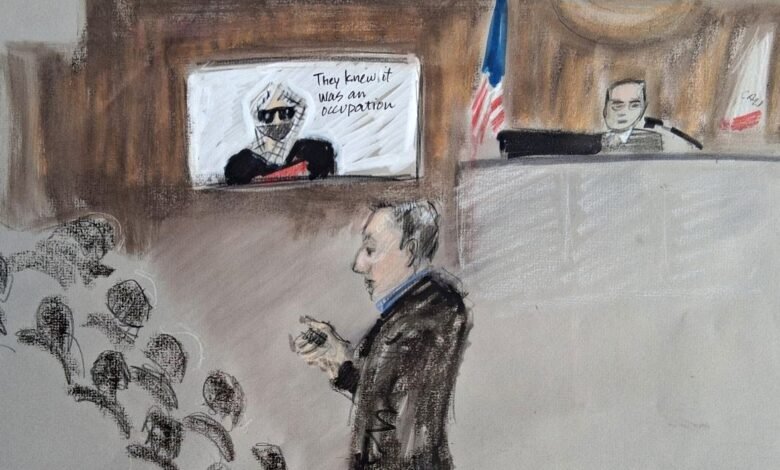
During closing arguments on Jan. 29, Deputy District Attorney Robert Baker characterized the group’s preparations for the building takeover as evidence of guilt.
Displaying screenshots from planning documents that included a list of attorney names, Baker suggested that the defendants were aware they were about to commit a crime and were anticipating arrest.
Two of the attorneys listed in the documents ended up on the defense team: Singh and Abbee Cox, who represents Zhai.
Singh told the jury Baker was making a spurious claim by suggesting that awareness of possible arrest was evidence of criminal intent.
“Knowing of lawyers does not mean you are intentionally committing a crime,” Singh said.
Leah Gillis, the attorney representing Burke, filed a motion for mistrial on Jan. 29 following Baker’s closing arguments during which he implied that the defendants pursued trial “as an extension of their protest.” Baker predicted the defense attorneys would make arguments that “have no relevance” to the facts of the case — which he said itself was a concession to their clients’ guilt.
Gillis called Baker’s line of reasoning “inappropriate” and said the defendants were in trial solely “based on a belief of their innocence.”
Chew denied the motion on Jan. 30.
Twelve protesters were arrested on the day of the building takeover. One later pleaded no contest. In October, the DA indicted the remaining 11 protesters. Prior to trial, six of the protesters received mental health diversion or agreed to guilty pleas on reduced misdemeanor charges, leaving five defendants.
The maximum penalty for felony conspiracy to trespass and felony vandalism is three years in state prison.
Rosen told J. in April 2025 that he would not recommend incarceration. At the time, he suggested they “make restitution to Stanford University” and perform court-ordered cleanup work.