
The life of Herbert Heller, the longtime San Rafael resident and Holocaust survivor who died in 2021, was a sobering one. Born in Czechoslovakia, he survived the brutality of Auschwitz and came to America to start a new life.
Now his tragic youth and his decision late in life to tell his story have been brought to life in a film that will begin a short theatrical run, including in the Bay Area, on March 11.
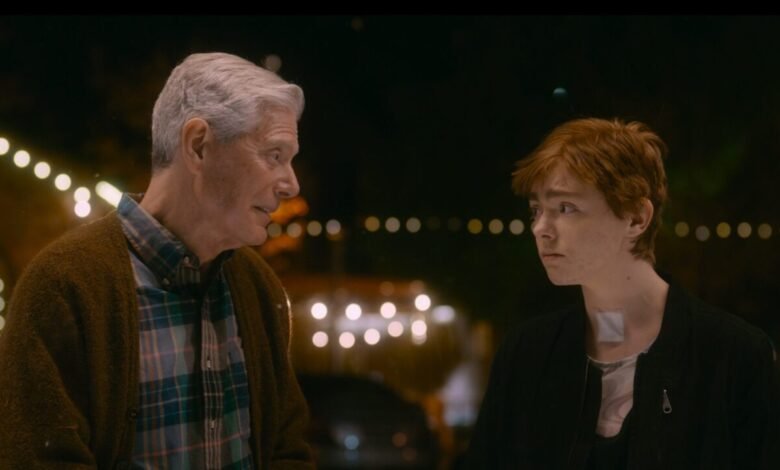
“The Optimist,” a fictionalized version of Heller’s life, is the passion project of Janine Thomas, who has pursued making the film for more than a decade. In it, a Holocaust survivor named Herbert, played by Stephen Lang, has hidden his past from the world but opens up to a troubled teen girl, played by Elsie Fisher. The film was originally titled “Avenue of the Giants” when it premiered in the film fest circuit in 2023.
Thomas, 54, who splits her time between the Bay Area and Maine, got to know Heller in 2014. It was an instant connection.
“I hung out at least every other week with Herbert until he passed, spent a lot of time with him,” she said. “He was like my own grandfather.”
One day after seeing him speak about his story, she was struck with an idea: “I’m like, ‘Oh, this is a movie.’”

Heller’s life was certainly dramatic enough for one.
He was born in 1929 into a family of four that lived an average middle-class Jewish life in Prague, with a nice apartment and a family car. But the Germans invaded Prague when Heller was 10, at which point new restrictions began to close in on everyday life. One day, there was a knock on the door of the apartment. Heller was 13.
“They introduced themselves that they were from the Gestapo and they were going to take us to the train station later,” he told J. in 2020 when he was interviewed as part of a series on Holocaust survivors. “They told us, ‘One small piece of luggage.’”
His family first spent two years in Theresienstadt, where they lived together, but were eventually transported to Auschwitz.
Life at the death camp was unimaginably cruel.
“People starved to death or [were] beaten to death. They were so sickly,” he told J. “The place we stayed was surrounded by high electricity wires and sometimes some of our people were just so desperate and sick that they ran to touch it and they were electrocuted. They just wanted to end their life.”
Even at 91, when he was interviewed, he remembered in detail the hangings they were forced to witness, the bitter cold they felt during winter, the lack of food and clothing, and the Nazi uniform colors — green for the Wehrmacht and black for the SS, who he said “were the cruelest. They’d just as soon kill you as do anything else.”

In “The Optimist,” the revelation of his secret past helps Abby, the teen girl, move toward healing.
“I created a teen storyline to pull in younger kids to want to watch this film, rather than being told at school they have to watch it,” said Thomas, a mother of four.
Like the character in the movie, the real-life Heller hid his story from his family for a long time. He removed his Auschwitz tattoo with acid after running away during the death march out of the camp. He told his children it was a burn from a water heater.
“I never wanted to talk about it because I never wanted anyone to feel sorry for me,” he told J. in 2020.
His daughter Diane Heller tears up when she thinks about it. “It’s kind of hard for me to comprehend that he had to go through that, and he kept that to himself,” she said. “I guess he didn’t want to burden us.”
He finally told his story as part of an oral history project in 2004. After that, he began speaking at schools and youth groups.
Heller and his mother were the only immediate family members who survived the Holocaust. They came to San Francisco in 1946 when Heller was 17. He spoke almost no English and had only a fifth-grade education. He quickly remedied that by going to night school and getting a job at Woolworth, then Macy’s. In 1958 he opened his own business in San Rafael: Heller’s for Children.
For Thomas, who was not raised Jewish but discovered Ashkenazi heritage later in life through a DNA test, making a movie about Heller felt important. But it was only after she suffered serious health issues that she made it a priority. Covid slowed the movie-making process down, but Thomas found a director and writer in Finn Taylor and financed the film mostly herself. She did hours of recording with Heller and will release a documentary on streaming platforms as a supplement to the film in a few months.
For Heller’s daughters, seeing their father’s life play out on screen has been emotional.
“I’m over 60, finding out — wow,” Vivian Cohen said. “He shielded us from that pain, you know.”
But Cohen said that she and her sisters deeply appreciate how the film demonstrates their father’s impact on others.
“For me, in a way, it’s bittersweet, because he didn’t talk about it growing up, and we didn’t find out about it till we were older,” Diane Heller said. “I’m grateful that now we know the reality of what my dad endured. And, then, it’s important for my children, the next generation, to understand our family legacy.”
The main thing, Thomas said, is that the film is meant for everybody.
“I think it’s one of the only films that you can, as a parent, grab your parent and your child and say, ‘Let’s go see this film,’ and you all have something to talk about,” she said. “It touches everyone.”
Heller’s daughter Linda Levy agreed. “With so few Holocaust survivors left,” she said, “the film is a vital way to preserve that spirit and share this important message with a wider audience.”