

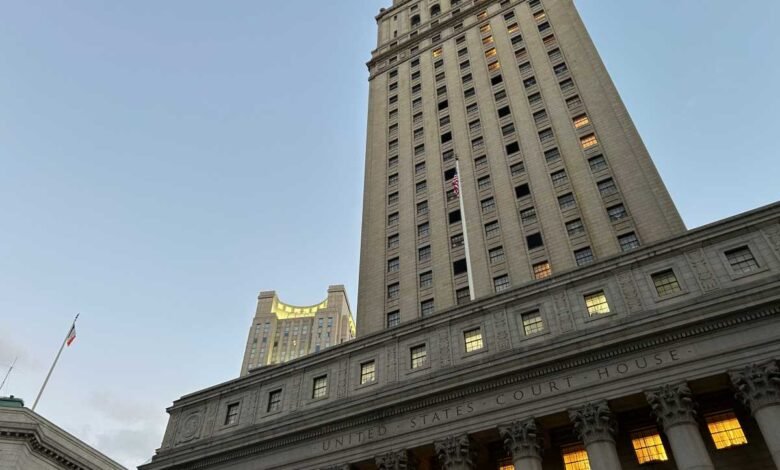
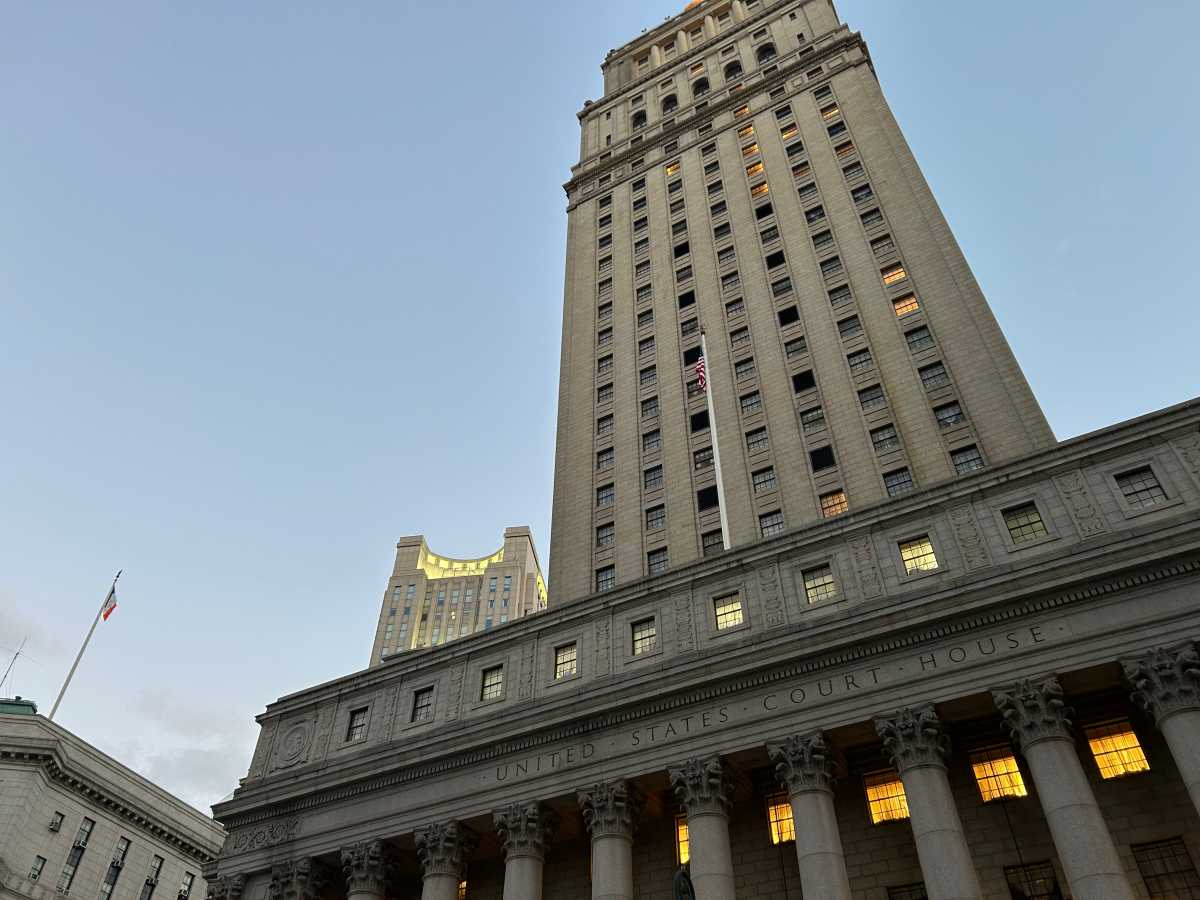
The Thurgood Marshall United States Courthouse at 40 Foley Square in Manhattan.
Photo by Andrew Denney
Foster kids whose relatives were denied certification to care for them, sometimes based on decades-old criminal convictions, revived their civil rights suit on Monday as a federal appellate court declared they have standing to sue New York City and Gov. Kathy Hochul.
Judges reversed a lower court’s dismissal of a lawsuit brought by 14 children whose family members wanted to become “kin caregivers” recognized by the state, a status that qualifies them for subsidies, medical care and caregiver training. The plaintiffs say the denials breached their relatives’ due process rights in the lawsuit first filed in Brooklyn federal court.
Finding lack of standing, and reasoning that the plaintiffs asserted only the rights of their third-party relatives, the trial court dismissed the suit.
That was a mistake, the U.S. Court of Appeals for the Second Circuit said.
“The plaintiffs have suffered a real-world harm: They have been denied a certified placement with a relative foster parent,” U.S. Circuit Judge Steven Menashi wrote for the three-judge panel.
He went on to note that kids who weren’t placed with another foster family were denied the medical and social services that come with foster placement, and those in the care of non-relatives were exposed to the risks of mental and emotional harm.
“These are real-world injuries, traceable to the defendants, and redressable by a favorable ruling. The district court erred by ruling otherwise,” Menashi wrote.
He was joined on the decision by U.S. Circuit Judges Michael Park and Maria Araújo Kahn.
Lisa Freeman heads up the Special Litigation and Law Reform Unit with the Juvenile Rights Practice at the Legal Aid Society, which represents the plaintiffs along with the firm Dechert LLP.
She called the decision “a powerful recognition that children’s constitutional rights may be violated when the state blocks them from living with their families.”
“The court made clear that denying children placement with relatives may deprive them of stability, vital services, and family connections, as well as expose them to serious emotional and psychological harm,” Freeman said in a statement Monday. “This ruling affirms that children have their own constitutional rights at stake when government policies deprive them of willing and capable kin foster parents.”
A spokesperson for NYC’s Administration for Children’s Services responded to the ruling in a brief statement: “Finding safe, loving homes for children who need to come into foster care is essential. We are reviewing the decision of the 2nd Circuit.”
The panel found some claims were moot, because two plaintiffs are now in the care of a relative foster parent, and another has aged out of the foster system. Reversing in part and affirming in part the lower court’s ruling, the judges remanded the case, which also names New York State Office of Children and Family Services Commissioner Sheila Poole, to the Eastern District of New York.
Kin caregivers and automatic dismissals
When he was just 3 months old, B.B., the lead plaintiff in the 2021 case, was removed from his mother’s care and released to the care of his great-grandparents. The couple helped the young child, who has autism and is nonverbal, learn some sign language to communicate with his family, and even saved his life by getting him medical treatment for chronic lung disease and asthma.
But B.B.’s great-grandparents weren’t approved to get financial support as parents under the state’s kin caregiver program because back in 1995, the child’s great-grandfather was convicted of attempted burglary in the second degree. The count is one of the 300 felony charges that warrants either lifetime or five-year mandatory disqualification.
“Children who spend time in stranger foster care have poorer school performance and are more susceptible to homelessness, arrest, chemical dependency, and mental and physical illness than children who remain with their families,” the federal complaint says.
Kids placed with family members, in turn, have reduced trauma and higher rates of behavioral and emotional well-being, according to a 2018 New York City interagency report.
Through foster parent certification, families can get child care subsidies from the state, and foster children are automatically eligible for Medicaid and post-adoption services, like counseling and caregiver training.
Until 2008, foster and adoptive parents went through individual assessments, according to the complaint — but then the state began automatically denying the applications of people convicted of certain felonies, including criminal marijuana possession and possession of a weapon.
In addition, a discretionary system can block prospective kin caregivers based on past charges alone, and based on anyone in the household over 18 ever having been the subject of an indicated report in the state’s child abuse registry.
The plaintiffs want to do away with the automatic dismissals, which they say are unconstitutional, and to return to individualized evaluations.
Source link